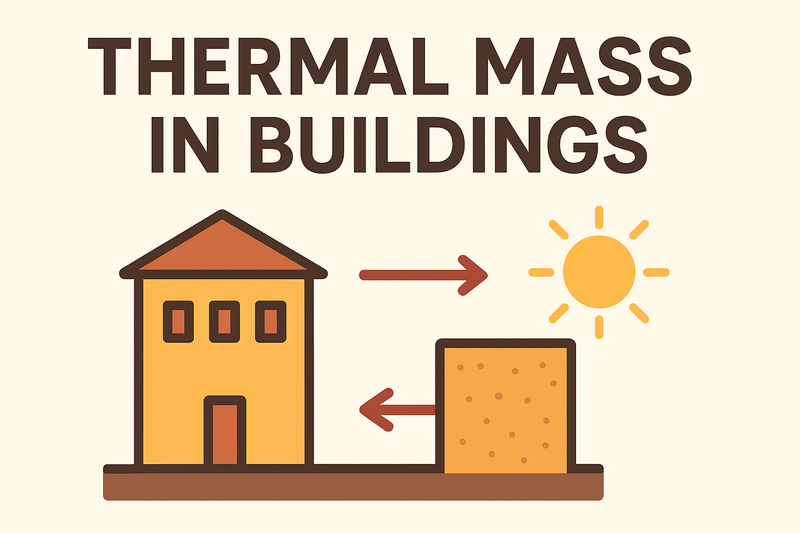
The thermal mass of a building structure and the interior furnishings is something that is supposed to be estimate during your load calculations. The Radiant Time Series (RTS) and Heat Balance (HB) calculation methods require this estimate to help determine the general time delay of heat gain in the space and through the building envelope to properly estimate how much heat extraction must occur in the air handling equipment to satisfy space loads.
Other calculation methods, such as the cooling load temperature difference (CLTD) or total equivalent temperature difference (TETD), do not require these kinds of estimates. Instead, they take conservative estimates of heat extraction rates, causing cooling equipment to be generally oversized.
Thermal mass is accounted for in two separate ways. first, the heat absorption of the building envelope from heat conducting through the walls and roof, and secondly, the heat absorption of of the building structure such as slab floors, structural beams, interior block walls, partitions, and furniture.
The building envelope is the barrier between the inside and outside environments: the walls, windows, floors, roofs, etc. Items like windows and skylights have negligible thermal mass, and it is assumed that heat will conduct through them according to the basic conduction equation . In a steady state condition, the heat conduction through a wall or roof follows the same conduction equation. However, the idea of accounting for thermal mass in the building envelope is that it is not a steady state system, because heat is being absorbed by the building materials during the day and released over time.
This transient concept is computed using Conduction Time Series (CTS) values, which are provided in Chapter 18 of the ASHRAE Fundamentals Handbook. These values provide a method of computing delayed heat gain over time, and are primarily dependent on the thermal mass of the envelope materials. Heavier materials can absorb more heat, whereas lighter materials will reach a steady state condition much quicker.
Heat extraction required by the cooling equipment is delayed due to the absorption of heat by the building materials, both in the building envelope and internal mass such as furniture, floors, and partitions. This heat gain is described by a similar set of values called Radiant Time Series (RTS) values, found alongside the CTS values. While the CTS adjustment is applied to all heat conduction through the building envelope, the RTS adjustment applies to all radiant heat gain in the space. This is an important concept because all heat gain in the space much be split into its convective and radiant portions.
This idea also applies to the heat entering the space through the building envelope. The CTS adjustment describes the delay as heat moves through the envelope, but once the heat has made its way through to the interior surface, the heat entering the space air from that surface is split into a radiant and a convective portion. The heat from all other sources such as people, light, equipment, and solar transmittance through windows, is also split into radiant and convective portions, and those specific portions are dependent on the nature of the heat sources.
The RTS adjustment then applies to all radiant heat gains, which estimates the process of radiant heat absorbing into the thermal mass of the space. This is not applied to the convective heat gain because it is assumed that convective gains are picked up directly to the air, requiring immediate (or nearly immediate) heat extraction from the cooling equipment. The total time delay of this radiant heat is again dependent on the total thermal mass in the space. Buildings with heavy concrete floors, fire walls, heavy wood furniture, and carpets, will be able to absorb much more heat than those with wood floors, light drywall partitions, and tile floors.
If thermal mass is not correctly estimate during load calculations, the peak cooling requirement from your cooling equipment may be overestimated or underestimated. The necessary instantaneous heat extraction required at the cooling coil is highly dependent on the nature of heat absorption by building materials, and the thermal mass of building materials can span a huge range, providing noticeably large differences in peak cooling loads.
By accounting for thermal mass in buildings, you are turning cooling load calculations from a steady-state to a transient computation. This is highly recommended, because cooling load calculations are already based on conservative estimates of coincident loads - peak occupancy, lights on, equipment running, clear skies, etc.
With the capability of modern computers and modern software, ASHRAE no longer even recommends methods such as CLTD or TETD, and instead recommends RTS or HB. Both the HB and RTS methods account for the highly transient nature of cooling loads, however the HB method is significantly more computationally intensive. For this reason, HeatWise uses the RTS method for its calculation procedure, maximizing value of accuracy relative to computational power expended.