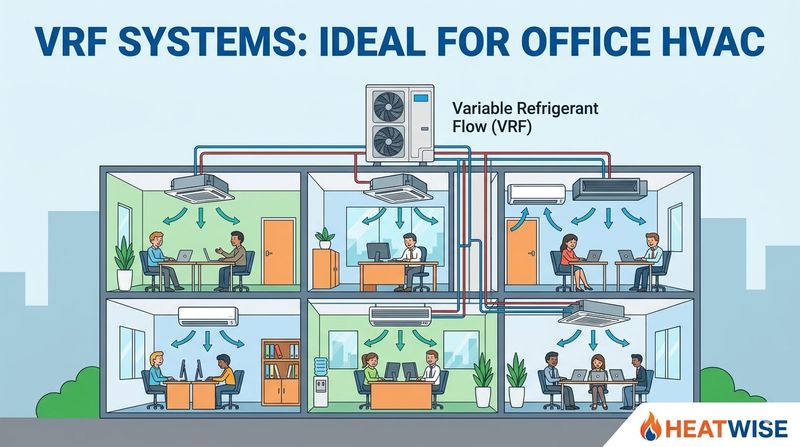
When engineers set out to design HVAC systems for modern office buildings in hot and humid climates, the challenge is rarely about peak capacity alone. Real buildings experience constantly shifting loads across spaces, seasons, and occupancy patterns. Designing for the “worst case everywhere” often leads to oversized systems, and inefficient operation, and occupant discomfort due to mismatched load profiles.
To explore what an ideal solution could look like, a 4500 ft2 multi-zone office building in Atlanta, Georgia was modelled using HeatWise load calculation software. The goal was not to retrofit an existing structure, but to determine what system type would best serve a well-designed, modern office from day one.
The results strongly point toward a heat-recovery VRF system such as those offered by Mitsubishi Electric.
Atlanta combines:
Even a thoughtfully designed building will experience diverse thermal conditions across its interior.
For this project, the modelled office included:
All zones were assumed to meet modern envelope and ventilation standards — in other words, a realistic but optimized contemporary design.
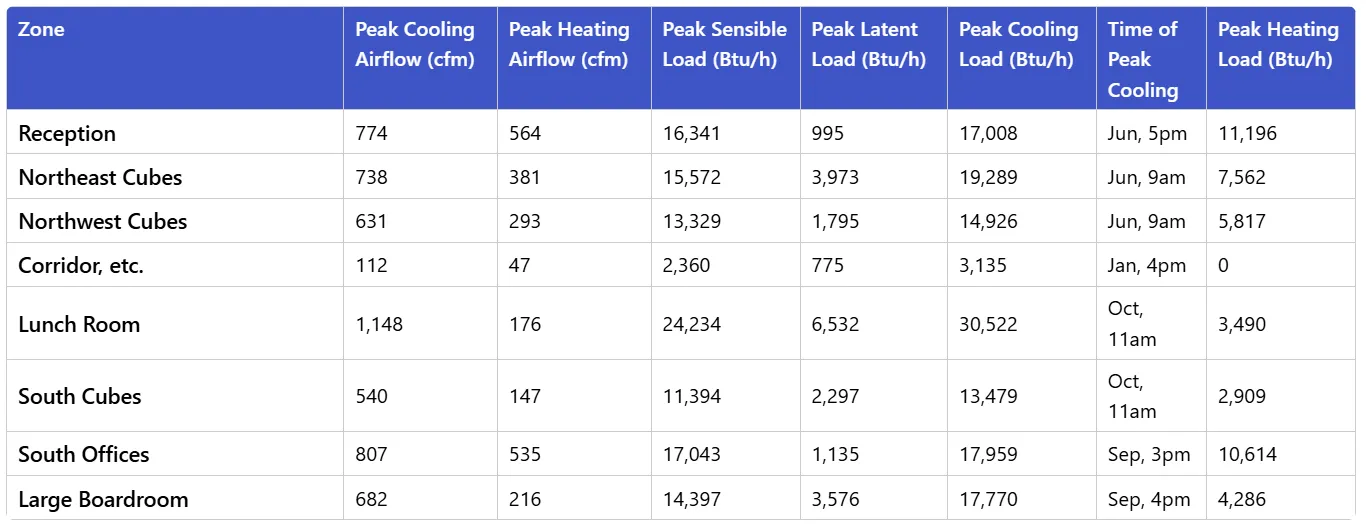
HeatWise simulations showed peak cooling loads ranging from about 3,000 Btu/h to over 30,000 Btu/h, depending on the space.
More revealing than the magnitudes, however, was the timing.
In the model:
This diversity arises from solar orientation, occupancy schedules, equipment use, and ventilation loads — factors that persist even in high-performance buildings.
A system designed under the assumption of coincident peaks would be oversized most of the time.
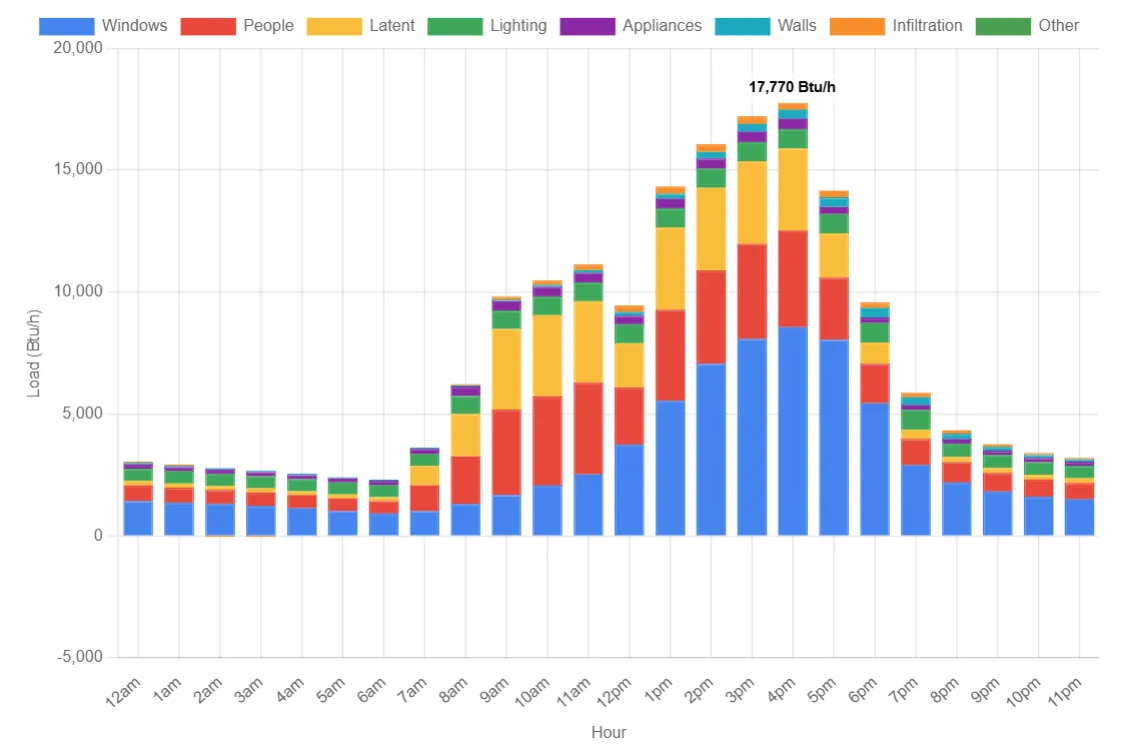
High-occupancy spaces such as the lunch room and boardroom showed substantially higher latent loads than private offices or corridors. These spikes occur due to
However, in both cases the latent loads tend to be short-term and transient. Meaning that controlling other spaces based on the loads in these rooms may overcool adjacent rooms. And controlling these spaces based on loads in the adjacent rooms will leave these rooms with a lack of cooling when they are fully occupied.
Attempting to satisfy all spaces without the right equipment is bound to leave some people uncomfortable. An ideal HVAC design must maintain humidity control without sacrificing efficiency during low-load conditions.
Although cooling dominates annual energy use, the model showed meaningful heating requirements in perimeter zones during winter and shoulder seasons.
Importantly, some spaces required heating while others still needed cooling — a classic transitional condition in well-insulated buildings.
This is precisely where many conventional systems struggle.
A heat-recovery VRF system aligns remarkably well with the load profile of this model building.
Instead of conditioning the building as a single entity, VRF treats each space as an independent thermal environment.
Indoor units modulate continuously, delivering only the capacity required — whether that is a small corridor load or a heavily occupied meeting space.
This approach maintains comfort while avoiding the inefficiencies of oversizing, and without compromising the comfort of neighbouring rooms.
One of the most compelling findings from the model was the frequency of mixed load conditions.
Heat-recovery VRF systems can transfer energy internally: Heat removed from cooling zones can warm zones needing heat
This internal energy exchange reduces outdoor heat rejection and dramatically improves seasonal efficiency.
Because peaks are non-coincident, the building rarely operates at full capacity.
VRF systems are specifically designed to perform efficiently at part load, providing:
Longer runtimes at lower output help maintain coil temperatures conducive to moisture removal — essential in humid climates.
This makes VRF particularly well suited for spaces with intermittent occupancy spikes, such as lunch rooms and conference areas.
In an ideal new design, mechanical space efficiency is highly valuable. VRF systems use compact refrigerant piping instead of large duct trunks, enabling:
In some projects, engineers may choose multiple independent heat-pump VRF systems rather than a single heat-recovery system. Grouping zones with similar load profiles onto separate outdoor units allows each system to operate in either heating or cooling mode independently, without the added complexity of branch controllers or three-pipe refrigerant distribution.
This approach can be effective in buildings where thermal needs are predictable by orientation or use — for example, perimeter offices on the south façade that predominantly require cooling, and interior spaces that mostly require heating. In such cases, simultaneous heating and cooling within the same zone group is minimal, so the added cost and complexity of heat recovery may not provide significant benefits.
Multiple heat-pump systems can also offer advantages in redundancy and phased construction, since each system operates independently.
This examination demonstrates that system selection should be driven by how a building actually behaves, not just by peak totals.
HeatWise enabled designers to visualize:
Armed with this information, it becomes clear that flexibility and modulation — not brute capacity — define an optimal solution.
Load calculations determine how big your equipment should be, but design and equipment selection require more than just equipment capacities. HVAC designs must consider how a building will actually behave, and what matters to the occupants, owners, and operators of the building. This is where VRF systems prove themselves to be the superior option in many cases.
Even in a well-designed, modern office building, thermal demands vary dramatically across zones and time. Systems that assume uniform conditions inevitably sacrifice efficiency and comfort.
A heat-recovery VRF approach or a multi-unit heat pump system — such as those pioneered by Mitsubishi Electric — represents an ideal match for buildings characterized by:
When paired with sophisticated modeling tools like HeatWise, engineers can design HVAC systems that reflect real-world operation from the outset — delivering comfort, efficiency, and adaptability for years to come.
For more information and support on VRF systems, get assistance from the VRF experts: Mitsubishi VRF Design Support.
Original Post at: www.heatwise-hvac.com/blog/mistubishiheatwisevrf/